For your business
A prioritised view of repeat work, waiting time and exceptions to test before wider adoption.
AI Automation for Repetitive Work
Workshop for organisations / TAILORFIT LEARNING
How much are you paying for the same repetitive work every month?
Identify repetitive work worth reducing and design automated steps with the necessary checks.

A prioritised view of repeat work, waiting time and exceptions to test before wider adoption.
Evidence to decide where automation deserves investment and how released capacity could be used.


We match facilitators and specialists to the challenge and learners. The proposal identifies the delivery team, roles, activities and scope before agreement.
Meet our team and approach →The four-week pilot plan is an output for your team to use; four weeks of follow-up services are not automatically included.
Final content, deliverables and duration are agreed after we understand your challenge.
1 day / 6 hours: THB 59,000 · 2 days / 12 hours: THB 115,000 · Up to 15 participants
One course per cohort · Thai-language delivery on weekdays at your organisation
One online briefing of up to 45 minutes; activities adapted from the existing course for one main challenge; facilitator, coordination, digital materials, templates and review during workshop hours.
AI packages include one workshop assistant.
1 day: learn, practise and draft outputs. 2 days: work more deeply on the same course, with feedback and revisions around your team’s challenge.
Venue, catering, travel, accommodation, VAT if applicable, software, English-language delivery, weekends, additional participants and wholly new course design are quoted separately before agreement.
Production deployment and post-workshop follow-up services are not included. Pilot and practice plans are outputs for your team to use afterwards.
Organisational transformation consulting, AI adoption and bespoke process improvement are scoped and quoted separately.
Budgets reflect the scope above. Final pricing and the delivery team are confirmed in the proposal before agreement.
Request a proposal for your team →Compare time per item, rework, waiting time, tool costs and the human review still required.
Include workshop fees, learning time, tools and human review. The value of released capacity is not automatically a cash saving.
These figures teach pilot planning; they are not client results or promised outcomes. Measure your own baseline before committing to a tool.
120 requests × 12 minutes = 24 hours a month. The trial target is four minutes per request, or eight hours a month, including the time people still spend reviewing.
If 16 hours a month are freed × an assumed THB 400 loaded labour cost per hour × 12 months, that is capacity available for other work—not immediate cash savings or guaranteed profit.
Illustrative baseline: 18 a month. Trial target: no more than nine, with the reasons logged so automation does not merely hide errors.
How to verify it: capture at least two weeks of baseline data, run a bounded four-week trial, then compare total human review time, rework, accuracy and tool/support costs before judging the business case.
1 day: map the before-and-after process, choose suitable tasks and draft a pilot with sample data. 2 days: workshop your team's workflow, controls, exceptions and a measurable trial plan.
We discuss participants’ experience, roles and challenge before agreeing the activities. Bring a shareable form or workflow, a rough monthly volume, time spent and examples of rework. No confidential supplier records are needed.
Begin with sample data or examples you can share. Live data, permissions and tools must be agreed under your organisation’s requirements.
Fees depend on the challenge, participants, duration and outputs. Also consider tool costs and your team’s implementation time. System deployment or managed operations are not automatically included.
The four-week pilot plan is an output for your team to use; four weeks of follow-up services are not automatically included. Your organisation assigns owners to test and measure the work. Additional services require a separate agreement.
It is Friday afternoon. Procurement opens another purchase request, copies supplier details and amounts from the attachment into a tracker, then sends it to Finance. On Monday the manager asks where approval stands. Each person checks a different app, and one amount does not match the source document. The request goes back around. No single task is difficult; the repeated copying and waiting are the problem.
Illustrative scenario, not an actual client case
Automating a muddled process can move mistakes faster. This course starts with the entire handoff: where information arrives, what gets re-entered, what waits for approval, and what still needs a person's judgement. Only then do we decide whether a simple rule, AI-assisted document reading, or no automation at all makes sense.
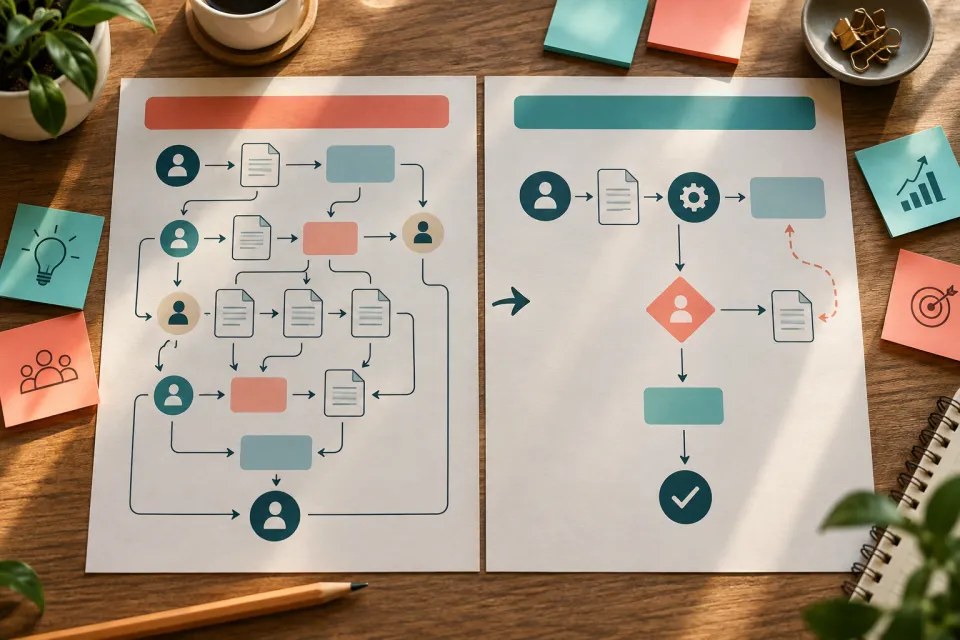
In our fictional case, a team handles 120 purchase requests a month and spends about 12 minutes per request re-entering details and chasing status: 24 hours a month. In the room, we redesign that path with sample documents: receive → validate key fields → route routine items for approval → send exceptions to a person → record a traceable status. We do not connect live systems or let AI approve payments.
Teams begin with fictional forms and effort estimates, then adapt the method to their own workflow. Each stage asks what to remove, what a system may handle, and who takes over when the input is wrong or the system is unavailable.

Map the work before changing it: trace a purchase request from intake to approval, recording re-entry, hands-on time, waiting time and the reasons it gets sent back.

Sort automation candidates: distinguish fixed-rule steps, documents AI might help read or classify, and decisions that remain human. Rank options by volume, risk and data readiness.

Design the safer future flow: specify required fields, checks against the source, routing and status updates. Work through unreadable documents, outages, an audit trail and the approval gate for consequential actions.

Plan a four-week pilot: choose one low-risk step, name an owner, capture before-and-after effort and rework, include tool costs, set stop criteria and schedule a review before expanding.
ThinkToFinishTAILORFIT LEARNING
COURSE BRIEFA starting summary for your team and approvers
Cut re-entry and waiting time without losing the checks that matter
Operations, procurement, finance, service and process-improvement leaders
Bring a shareable form or workflow, a rough monthly volume, time spent and examples of rework. No confidential supplier records are needed.
1 day: map the before-and-after process, choose suitable tasks and draft a pilot with sample data.
2 days: workshop your team's workflow, controls, exceptions and a measurable trial plan.
1 day / 6 hours: THB 59,000 · 2 days / 12 hours: THB 115,000 · Up to 15 participants
One course per cohort · Thai-language delivery on weekdays at your organisation
One online briefing of up to 45 minutes; activities adapted from the existing course for one main challenge; facilitator, coordination, digital materials, templates and review during workshop hours.
AI packages include one workshop assistant.
Venue, catering, travel, accommodation, VAT if applicable, software, English-language delivery, weekends, additional participants and wholly new course design are quoted separately before agreement.
Production deployment and post-workshop follow-up services are not included. Pilot and practice plans are outputs for your team to use afterwards.
Budgets reflect the scope above. Final pricing and the delivery team are confirmed in the proposal before agreement.
Final content, deliverables and duration are agreed after we understand your challenge.
We first ask what needs to improve, who will act and what progress would look like. Then we adapt the activities and outputs to your team.