For your business
A shared definition of measures, accountable owners and a record of decisions and follow-up dates.
BSC, KPIs and OKRs That Inform Decisions
Workshop for organisations / TAILORFIT LEARNING
Do reports fill your desk without making the next decision clear?
Practise connecting goals, measures and review meetings to decisions.

A shared definition of measures, accountable owners and a record of decisions and follow-up dates.
A clearer basis for reviewing performance, assigning action and deciding what deserves attention.
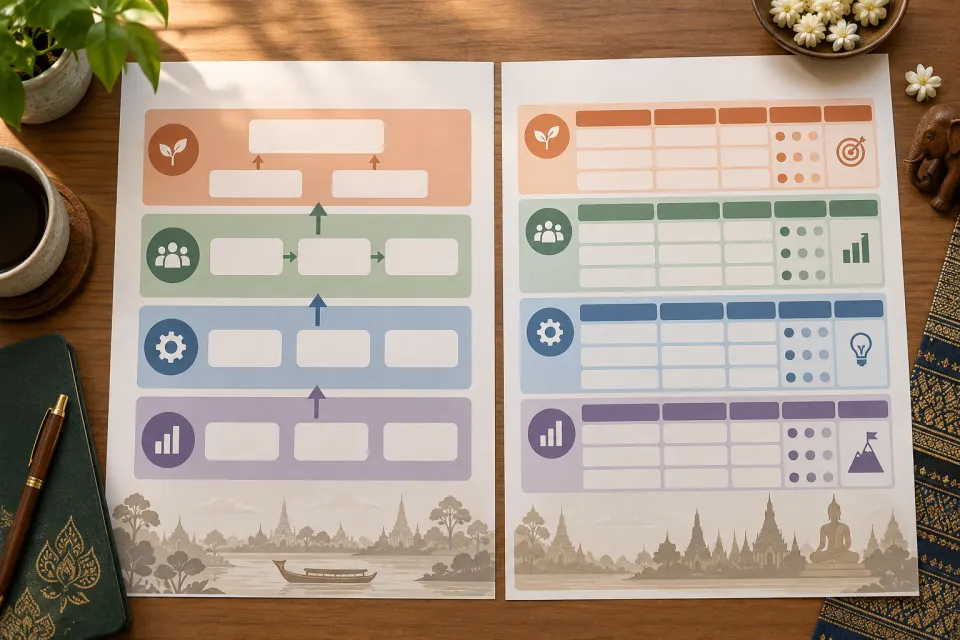

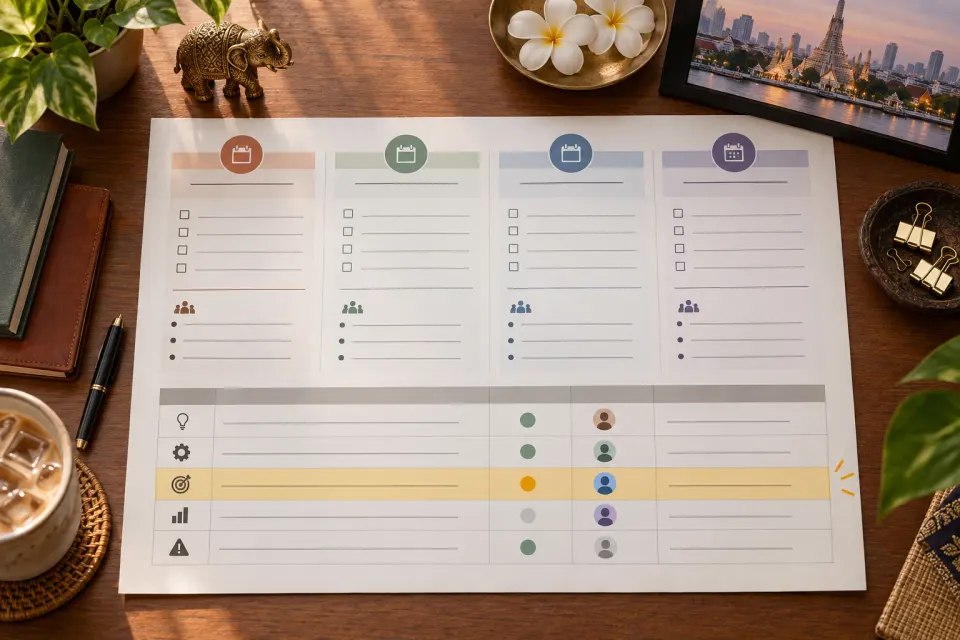
We match facilitators and specialists to the challenge and learners. The proposal identifies the delivery team, roles, activities and scope before agreement.
Meet our team and approach →Drafts and examples are intended for adaptation and follow-through in your organisation.
Final content, deliverables and duration are agreed after we understand your challenge.
1 day / 6 hours: THB 49,000 · 2 days / 12 hours: THB 95,000 · Up to 20 participants
One course per cohort · Thai-language delivery on weekdays at your organisation
One online briefing of up to 45 minutes; activities adapted from the existing course for one main challenge; facilitator, coordination, digital materials, templates and review during workshop hours.
AI packages include one workshop assistant.
1 day: learn, practise and draft outputs. 2 days: work more deeply on the same course, with feedback and revisions around your team’s challenge.
Venue, catering, travel, accommodation, VAT if applicable, software, English-language delivery, weekends, additional participants and wholly new course design are quoted separately before agreement.
Production deployment and post-workshop follow-up services are not included. Pilot and practice plans are outputs for your team to use afterwards.
Organisational transformation consulting, AI adoption and bespoke process improvement are scoped and quoted separately.
Budgets reflect the scope above. Final pricing and the delivery team are confirmed in the proposal before agreement.
Request a proposal for your team →Check whether reviews record decisions, owners and follow-up dates, and assess the quality and meaning of the underlying data.
Include workshop fees, learning time, tools and human review. The value of released capacity is not automatically a cash saving.
Planning assumptions, not actual client results or promises. Measure your own baseline first.
Eight managers × four hours = 32 hours a month. The trial target is two hours each, or 16 hours altogether.
Sixteen hours a month × an assumed THB 400 loaded labour cost an hour × 12 months. This is capacity for analysis and decisions, not cash savings or guaranteed profit.
A fictional ten a month could become no more than six, counting items with no owner or follow-up date.
How to verify it: measure preparation time and unowned actions for at least two monthly cycles, test the new definitions and review rhythm for two cycles, then assess time, data quality and decisions actually made.
1 day: clarify BSC, KPI and OKR roles; draft a strategy map and measure definitions. 2 days: build a scorecard and KPI/OKR set around your challenge, then rehearse a decision-focused review.
We discuss participants’ experience, roles and challenge before agreeing the activities. Bring a shareable organisational goal, a current performance report and a question the existing measures cannot answer; remove sensitive details.
Begin with sample data or examples you can share. Live data, permissions and tools must be agreed under your organisation’s requirements.
Fees depend on the challenge, participants, duration and outputs. Also consider tool costs and your team’s implementation time. System deployment or managed operations are not automatically included.
Drafts and examples are intended for adaptation and follow-through in your organisation. Your organisation assigns owners to test and measure the work. Additional services require a separate agreement.
At month-end, every department's KPI slide is green. Sales made its number and Operations cleared its queue. Then an executive asks whether customers are actually returning more often. Nobody can tell. The measures are not all wrong; they describe separate jobs without showing the cause-and-effect path to the outcome the company wanted.
Illustrative scenario, not an actual client case
This is not a workshop about filling another dashboard. We start with a strategic outcome, use a Balanced Scorecard to map cause and effect, KPIs to watch operational health, and OKRs to focus a time-bound change. Then we design a review where numbers lead to decisions, not merely reporting.
In our fictional case, eight managers each spend four hours a month assembling slides and answering repeated questions: 32 hours altogether. If definitions and review cadence become consistent, a sensible trial target could be two hours each, or 16 hours a month. The time released should go into understanding causes and deciding what to do next.
Teams work with a fictional Thai company's strategy and measures. They ask who owns the outcome, which measures lead or lag, whether definitions match across teams, and what decision a missed target should trigger.

Start with a strategic question: separate activity from outcome, identify changes needed in customers, processes and team capability, and assign an owner.

Draw a strategy map and Balanced Scorecard: connect balanced perspectives with testable cause-and-effect assumptions.

Give KPIs and OKRs different jobs: define formula, source, cadence, owner and interpretation for each KPI; set an Objective and Key Results for this cycle's change.

Rehearse a review: examine conflicting signals, investigate causes, record the decision, owner, follow-up date and when a measure itself needs revisiting.
ThinkToFinishTAILORFIT LEARNING
COURSE BRIEFA starting summary for your team and approvers
Make green metrics answer whether the strategy is moving
Executives, department heads, strategy, HR and PMO teams
Bring a shareable organisational goal, a current performance report and a question the existing measures cannot answer; remove sensitive details.
1 day: clarify BSC, KPI and OKR roles; draft a strategy map and measure definitions.
2 days: build a scorecard and KPI/OKR set around your challenge, then rehearse a decision-focused review.
1 day / 6 hours: THB 49,000 · 2 days / 12 hours: THB 95,000 · Up to 20 participants
One course per cohort · Thai-language delivery on weekdays at your organisation
One online briefing of up to 45 minutes; activities adapted from the existing course for one main challenge; facilitator, coordination, digital materials, templates and review during workshop hours.
Venue, catering, travel, accommodation, VAT if applicable, software, English-language delivery, weekends, additional participants and wholly new course design are quoted separately before agreement.
Production deployment and post-workshop follow-up services are not included. Pilot and practice plans are outputs for your team to use afterwards.
Budgets reflect the scope above. Final pricing and the delivery team are confirmed in the proposal before agreement.
Final content, deliverables and duration are agreed after we understand your challenge.
We first ask what needs to improve, who will act and what progress would look like. Then we adapt the activities and outputs to your team.